


Unlocking a Path to Launch a Career Training Space and Subsidized Housing in Carson City
By November 8, 2023 Community banking
When you think of a bank loan process, creativity and flexibility aren’t likely the first words that come to mind. But as it turns out, identifying innovative solutions to complex loan problems just so happens to be Plumas Bank’s specialty.
“As a community bank, we’re absolutely committed to the communities we serve,” said Ty Nebe, Plumas Bank senior vice president and ag/commercial loan officer serving his hometown of Carson City. “Community banks are the backbone of the financial arena — we aren’t a one-size-fits-all type of bank, and we have to be creative. We care about our clients within our communities, bringing something extra to the table to help businesses succeed — I call that value-added service.”
This value-added service is exactly the reason a major Carson City project is getting ready to open its doors to serve its community: If you’ve been to Nevada’s capital recently, you’ve undoubtedly noticed the FISH Student Housing Revitalization Project, a student housing initiative comprised of three 3-story buildings, including two 18-unit apartment complexes and a commercial building. The complex is on Carson City’s main thoroughfare and is taking over a formerly blighted motel site that was once called the Whistlestop Inn.
FISH, which stands for Friends in Service Helping, is using the space to open a transitional career training space — as well as subsidized housing — for adult students in trades programs working to pull themselves out of poverty.
Not Your Typical Construction Loan
With a total construction cost of $17 million, FISH had successfully raised a significant chunk through community support, local foundations, and donations. However, they still needed a loan to complete the project.
“We had raised about $12.7 million for the project, but we’re unique in that FISH doesn’t rely on the government for funding,” said Jim Peckham, executive director of FISH. “Less than 1% of our budget is from the government. The community supports us, as do local foundations and businesses through donations.” That presented a problem when Peckham sought a capital loan.
“A lot of banks were concerned that as a nonprofit, we rely on donations instead of the cashflow you’d see in something like a grocery store,” Peckham said, explaining why the FISH business model posed a challenge to identifying a funding source.
Then Peckham was introduced to Ty Nebe at Plumas Bank. Nebe, who sits on the board of the Northern Nevada Development Authority, was approached by local community leaders suggesting he meet with Peckham and offer guidance on how the project could access the funding it needed.
Peckham explained, “Plumas Bank understood we’ve been around 44 years, and that we have multiple properties that we own and manage with other parts of our services.”
Not only did Nebe and the bank manage to make available the necessary $7.7 million for the project to reach completion, but Plumas Bank also came forward with a $15,000 donation.
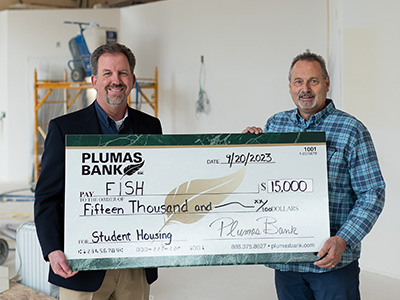
Pictured: Plumas Bank donates $15,000 to Carson City’s affordable housing and workforce development initiative – on top of providing a $7 million capital loan to complete the project.
Jim Peckham, Executive Director, FISH
Ty Nebe, SVP Commercial Lending
Photo credit: Lauren Casto
Creativity + Personal Approach = Community Banking
Nebe’s intimate knowledge of the community FISH serves and the work they do is what allowed him to tap into his creativity to arrange the loan.
“I had to structure it in a different way to make it work,” Nebe said. “They have their existing facility, so we did a line of credit on that, and then we did a construction loan on the existing project because of the way the appraisal was completed. With underwriting criteria, we’re limited on how much of a loan we can make, so we had to get a little creative to pull it all together.”
But pull it together they did — committing funding through a line of credit FISH has been able to tap into a few times to keep the project moving forward while additional donations come in. “As their bank, we are also good financial stewards and advise our clients that if they have excess cash flow, they should be using it to reduce debt,” Nebe said.
Plumas Bank and FISH: Partners in Financial Stewardship
Plumas Bank’s strong commitment to financial stewardship also aligns with the goal of FISH, which Peckham notes is to help locals move from “poverty to prosperity.”
“At FISH, we talk about providing a hand up, not a handout,” he added. “I could stand at the curb and give out $20 bills, and the line never goes away, so that’s not a solution. Instead, we’re offering a different take on it — what if, instead of building more affordable housing, we make fewer people reliant on it?”
That’s the overarching philosophy underpinning the FISH Student Housing Revitalization Project, which will provide subsidized housing and wrap-around services to underemployed students who are earning college-level technical certifications and training to qualify for higher-paying jobs, which will in turn help to grow the regional economy.
“Two of the more significant issues in our region are a lack of affordable housing and a lack of a skilled workforce,” Peckham said, adding that the workforce gap was primarily in trade jobs like nursing and lab techs, welders, long-haul trucking, manufacturing and construction. “And yet we can’t even hire outside of our region to help fill these open roles because there’s no place to live.”
FISH conducted interviews and a pilot program to determine how to make it possible for locals to move from minimum wage jobs to meaningful careers, discovering that about 80% of this population was comprised of single parents. They found that if they allowed this population to focus on their education by taking away concerns over housing, they thrived.
“It’s just a matter of taking the barriers out of the way so these underemployed individuals have the opportunity to make a bigger impact for themselves, for their families and for the community at large,” Peckham said.
If accepted into the FISH program, locals who join a trades program can take advantage of subsidized housing; many of the units have multiple rooms, allowing for families. The students, in turn, make a commitment that to keep their housing, they work hard to earn good grades, meet community standards on campus and in dorms, take advantage of life-skills training on the FISH campus and possibly even work in the commercial building, which will house offices and a restaurant space.
“Then after these students graduate, they transition to higher-paying careers with more benefits, so we’ve helped develop the pipeline serving our community,” Peckham described. “This frees up affordable housing for others to put through the program. We’ve revitalized the community, we’ve revitalized the workforce, and we’ve even revitalized the family, potentially taking a bite out of generational poverty.”
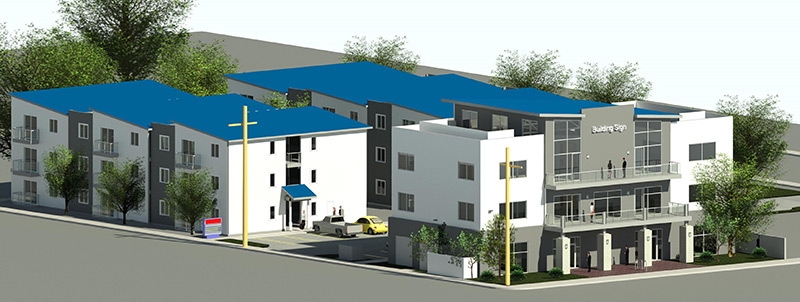
Rendering of the FISH Student Housing Revitalization Project in Carson City, Nev. The project is scheduled for completion in 2024.
Local Ties, Meaningful Project
Nebe agrees this first-of-its-kind project is a win-win for the community, adding that it also allows Plumas Bank to fulfill part of its community reinvestment mission.
“I think this is such a huge community story for Carson City,” he said. “I grew up in this area and never saw homelessness until I went to college. But now it’s a problem affecting every community.”
But, he adds, this initiative is doing more than just masking a problem with a Band-aid; it’s creating a more comprehensive solution by equipping locals with the skills and drive to help themselves.
“This is a way for someone potentially struggling to find a career and write their own success plan,” Nebe said. “I grew up as the middle child of three boys, and my mom told us daily: ‘You have to be involved in your community, you have to volunteer your time, you have to give back.’”
He says community projects like this remind him of this advice, adding that in his own family, his mom volunteered at every 4H event — and got her three boys involved, too.
“We were the only boys involved in sewing,” he laughed. “Not only did we raise animals, but we also sewed — that was just part of growing up on a ranch five miles out in the middle of nowhere.”
So watching FISH create this self-fulfilling revitalization path for locals — and having a role in helping the project come to fruition — further connects Nebe to his strong rural Nevada roots.
“It’s extremely rewarding,” he said. “Any time you help your clients, it’s very fulfilling. Watching an organization or business succeed and flourish in their goals is the reason why I got into lending.”
And this, he continues, is the competitive advantage at Plumas Bank with loan officers who know the local communities so well.
“People from local organizations or businesses — like FISH or any other — can walk in here anytime, talk to me, have a conversation as it relates to their needs and we can see what makes sense for them,” Nebe said. “Our goal is to help those businesses succeed. That’s why we’re here.”
At the time of publishing this story, the FISH Student Housing Revitalization Project has an interest list of 15 and is aiming to open its 36 residential units in time for the spring semester 2024.
You are leaving Plumas Bank.
The website you are about to visit is not operated by Plumas Bank. Plumas Bank is not responsible for the availability or content of this website. The privacy and security policies of the site may differ from those practiced by Plumas Bank.
Selecting "Continue" will open a new browser window.