


The Art of Paying Attention
By August 18, 2026 Community banking
Physicist and artist Christine Hartmann brings a colorful celebration of individuality to Plumas Bank’s new Red Bluff art exhibit
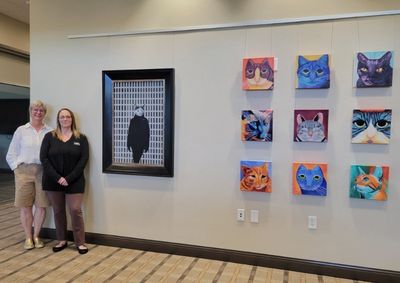
Walk into Plumas Bank’s Red Bluff branch, and you may find yourself staring into the eyes of a cat.
But this is no “typical” cat. She’s standing upright, a pensive gaze on her black-and-white face, humanlike arms hanging to their sides. She is dressed in a buttoned-up black coat and surrounded by a checkerboard grid of black rectangles and white lines resembling windows in an urban skyscraper.
Despite everything around her, she seems distinctly alone. Yet nearby, nine other cats are having an entirely different experience.
“They’re living their best lives,” artist Christine Hartmann said. “They’re living life in color.”
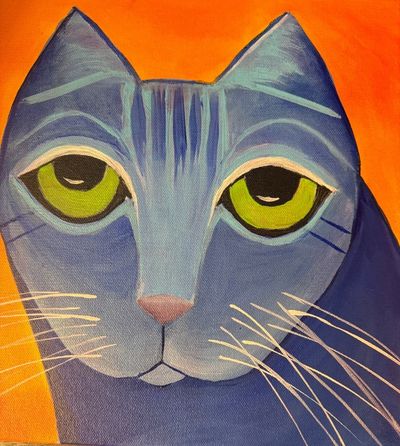
The cats have different styles, colors and gazes. Each seems perfectly comfortable occupying its own little square of the world. Together, they form part of Hartmann’s exhibit at Plumas Bank, presented in collaboration with the Tehama County Arts Council.
Hartmann is the first artist featured in the Red Bluff branch’s new exhibit space, created to showcase the work of local artists while bringing original art into a place people already visit as part of their daily lives.
For Hartmann, there may be no better place to invite people to look a little closer.
A Scientist’s Perspective
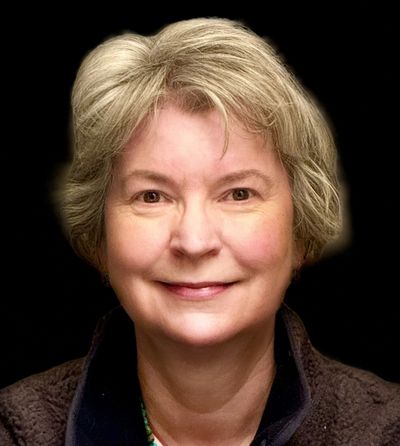
Hartmann spent roughly 30 years as a physicist before retiring in 2025 and turning her full attention to art. Painting entered her life much later.
“I got into art when I was in my 40s,” she said. “I was a single mom at the time, and a friend suggested that my sons and I come paint with her. That got me going, and I never stopped.”
As she painted, Hartmann began recognizing connections to the scientific world she knew so well.
“A lot of the designs that result from mathematical algorithms are beautiful,” she said. “The shapes that come out of good engineering, created for function, can also be beautiful.”
Eventually, she came to see art itself as a form of discovery. Hartmann believes science begins with paying close attention to what actually exists. Scientists develop models for how something works, test them against physical reality and adjust their understanding based on what they find.
Her approach to painting can look remarkably similar.
“In front of a canvas, I also have a model for something — how I think something will turn out or what I want it to be,” she said. “Then reality sets in, and it often becomes something else entirely.”
Along the way, she discovers something new about her subject, her original idea or where the painting wants to go.
“The deeper we pay attention, the more things we see and the more refined our ideas of the world can become,” she said.
Finding What’s Possible
Hartmann’s path into physics was shaped by personal loss. While she was in graduate school, seven family members died of cancer within roughly 18 months.
“It was unbelievable, but it also motivated me,” she explained. “I wanted to do something to improve the situation.”
Hartmann grew up on a farm in Wisconsin and arrived at the University of Wisconsin without the academic background she associated with a future physicist. But what she found there was a core of professors who believed in her and served as mentors.
“They saw something in me that I didn’t see in myself because I didn’t know what it was yet,” she said.
With help from her professors, she learned about the work of physicists.
“CT scans, MRI scans and radiation therapy were made possible because of physics, followed by a lot of engineering,” she said. “I found that incredibly exciting. If we can understand physical laws better and understand what they mean to us, we can unlock possibilities to reduce suffering and make the planet better.”
She went on to work in medical physics and radiation therapy, including at Lawrence Livermore National Laboratory. There she helped develop Peregrine, an advanced computer-based 3D treatment planning and dose calculation system designed to improve the accuracy of radiation therapy. Her career later took her into national security.
Through it all, Hartmann was fascinated by the possibilities that emerge when you study a problem closely and remain willing to try something new. And that instinct still follows her into the studio.
Sometimes, she described, a painter has to step back from a piece and ask: “What if I do something boldly different?”
Living Life in Color
That willingness to reconsider what we think we know also informs Hartmann’s interest in neurodiversity and what she calls “radical inclusion.”
“One of the biggest things I’ve learned through neurodiversity is nonjudgment,” she said.
She has become more conscious of the instinct to immediately label something as good, bad, beautiful, ugly or even normal. She tries instead to observe what is actually there.
“That was a behavior. That’s the way something looks. That’s the way something sounds or smells,” she explained. “I hope that comes across in my work. I think it makes for better art, and I think it makes for better people.”
Which brings us back to the cats.
Hartmann calls the collection a “self-portrait in disguise,” the solitary black-and-white cat reflecting the loneliness that can accompany feeling different. Yet the nine adjacent colorful cats offer another possibility.
“Sometimes we realize, ‘I’m different, and I feel alone because of that,’” Hartmann said. “There’s power in saying, ‘I am who I am. This is who I am.’”
Each of the nine cats has its own appearance and perspective. Hartmann sees beauty in the collection precisely because each one occupies the world in its own way.
“It’s a celebration of who we all are,” she said.
Come to the Table
Hartmann has found a similar celebratory spirit within the Tehama County arts community, where she lives and creates and serves on the board of the Tehama County Arts Council.
“One thing I love about the Tehama arts community is that it is so welcoming,” she said. “There is a diversity of styles, philosophies and ideas, and everyone is welcome.”
That openness has been especially meaningful to Hartmann. In some artistic circles, she said, aspiring artists can feel as though they need a certain level of expertise or education before their work deserves a place in the room. Tehama County has given her a very different experience.
“The cool thing about Tehama County is that the artists here say, ‘Come to the table. Come on over here. Start where you are. We’ll share what we know, you can share what you know, and we’ll all grow together.’”
It’s a philosophy that makes Hartmann a fitting choice to launch the new collaboration between Plumas Bank and the Tehama County Arts Council. The exhibit gives local artists another table to come to, this time in a community space where their work can reach people who may never have planned to spend their day looking at art.
Hartmann loves that idea.
“I think it’s very visionary for Plumas Bank to sponsor a venue that brings art to everyone,” she said.
She sees both art and science as invitations to resist assumptions about what is possible and remain willing to experiment, take risks and try something new.
A blank canvas requires that willingness. So does an unanswered scientific question. Hartmann sees plenty of applications beyond the studio and laboratory, including in business and everyday life.
Her hope for the new exhibit is wonderfully simple.
“I sincerely hope that having art in this branch in Red Bluff gives people a little inspiration to try some things,” she said. “It’s an invitation to just get out there — to just try.”
You’re Invited to View the Exhibit
Plumas Bank clients and community members can view Christine’s artwork on display at our Plumas Bank Red Bluff branch, 500 Riverside Way, Red Bluff, CA 96080, through November 2026. Visitors can stop by during normal business hours, 9 a.m. – 5 p.m., Monday through Friday. Special thanks to Tehama County Arts Council as we kick off a year-long collaboration of celebrating local artists.
You are leaving Plumas Bank.
The website you are about to visit is not operated by Plumas Bank. Plumas Bank is not responsible for the availability or content of this website. The privacy and security policies of the site may differ from those practiced by Plumas Bank.
Selecting "Continue" will open a new browser window.